Tuesday, June 16, 2020

Writing Family History: a note on how to write family history in 2020

How do I write my family history? Goodness, how many times have I been asked that question and I have answered, over the years and decades, in many ways through my workshops, books, writing my family stories and in talks and seminars....but of course how we write, and how we publish changes.  And just as history is now written in very different ways so too is family history.

Once it was enough to make lists of names and dates, perhaps as a pedigree often leaving out women's names as the purpose was to 'prove a line of descent,' through male lineage.  However, that emphasis on genealogy or an encyclopedic list of names is now less popular. Even the term family history is more common and denotes a broader, more inclusive approach to writing family stories.

It is true that as family historians we continue to map the many generations of families harking back to other centuries, other lands, these beginning somewhere outside our current place  unless we are indigenous.  It is also true that we 'choose' a line to research as family history – this is our favourite line, for me it was my mother’s family as I knew more about it.  And my mother told me many stories. For my father’s family my interest emerged much later.  My parents divorced in the 1950s and it was a time when such a separation was seen as difficult and my mother talked little about that time and certainly was not interested in that family history.

But as I aged and as I became more knowledgeable about family history I began researching my Kyle family history and was able to talk to my father and his many brothers and sisters before they passed on.  In fact 3 of my father’s sisters  are still going strong and they have given many insights and certainly stories for that side of the family.

We learn too, that family history iis made up of many different lines of ancestry from out parents and grandparents and these become increasingly complex if we were to  look at them all.  So we choose one or two lines  and simply focus specifically on that name or that lineage.

Nonetheless, in 2020 how we write our stories is very different to those first tentative steps we took in the 1970s and 1980s when the upsurge and interest in researching family history became popular.

What I see now in published family history and also in my own work is what I would call a mix of biography, memoir, history and family history.....we have become, along with other history, much more adventurous, much more imaginative and much more professional in how we research and then write our family histories.  Let me look at these four broad areas:

Biography  -  is to write the story of another person, in this case one of your family members.  There is little doubt that people are important in family history.  It is the lives of our ancestors, as we uncover them with our research, that shape and enliven our family stories.  It is possible today with the many online newspapers, birth/death/marriage records, government records, immigration and much more to fill out these biographies.  In the longer past how to find our ancestors lives is  more difficult but even then by looking at place in family (age, gender, large/small family, rural/city, poor/wealthy,  etc) you can assume much about that past and the people in it.


Memoir - an autobiography is the story of a life implying the writer will capture all elements of their life.  A memoir, on the other hand, does not replicate a whole life. Memoir can be stories or perceptions, of the author, on their own life, and on other peoples lives and events. In family history memoir can be simply that point in the story when you relate a story your mother/grandmother told you about the past and you comment on it because it changes what you knew about the family or it adds something or it challenges you...memoir is also your journey as a researcher and writer as you piece together the story and begin to understand it.


History -  adding in the 'big' picture is not a difficult nor a demanding task....each family story is unique but each story is familiar territory too. Family history is universal history. Birth, death, marriage, work, love, hope, joy anguish - these are common to all families, even in the long past.
As historians of our family, it is our job to link our stories, as much as it is possible, to the drama of neighbourhoods, to the hopes and dreams of local communities, and to the ebb and flow of national themes.  Historians, like all writers, draw inspiration from many sources;  memory, everyday experience, reading, work, film television. The literature we read - novels, biographies, historical and travel books, and the news section of newspapers or online - all provide creative stimulation for our writing.


Family History  -  is not everything that happened in the past!! Yes, it is true meticulous and systematic research is the cornerstone of good history. Writing family history is about asking questions?  Writing family history is writing about women and also about children, about aging and about conflict. Over the years I have learned much from family historians about research and indeed about writing. I have learned much from these students of life, of writing and family history, and am grateful for their wisdom, their generosity of spirit and their willingness to share. I have attended their monthly meetings where dedicated family historians support each other and where sharing of information, skills and technology are a given. In addition, there  is no doubt that family historians are some of the best historical researchers and their ability with and knowledge of online, digitised and new paper resources is amazing. But more than this  too.  Family history societies worldwide have incorporated citation, codes of ethics,, the stories of women, indigenous and migrant stories into  their family stories.And to ask the questions: how, who, where and in what historical help to shape the family narrative in a coherent and unique way.

Sunday, June 7, 2020

Women working in NSW Gaols

I am conducting research into the lives/careers/family of women who worked in NSW female gaols in the nineteenth and first decades of the 20th century.  My look at other research seems to indicate a focus to date on the female prisoners, especially notorious/controversial women, and very little interest on the women (wardresses/matrons/superintendents/nurses/etc) who were appointed from the 1800s onwards.

My previous research (see for example):

Women’s Business Midwives on the Mid North Coast of NSW:
http://www.macleayargus.com.au/story/4909521/women-through-the-ages/
http://www.macleayargus.com.au/story/4758932/midwives-of-yesteryear/?cs=12
On Nurses and Midwives in Australian History http://www.nswnma.asn.au/book-me-june-2015


 into women who worked as independent midwives, teachers, nurses and in social welfares positions had a definite pattern to them.

 In the early decades the wives of male appointees (in the female factories, refuges, orphanages, industricl/reformatory schools, asylums etc)   would take on the role of overseeing womens' and girls' institutions and early research indicates that this was  followed in the female gaols as they were established.

I am especially interested in the women who were appointed to senior administrative positions in NSW gaols and/when/if they were appointed in their own right rather than under the superintendence of a male governor/gaoler. I am also interested in how these women were trained, their previous positions/experiences, their marital status, and their career/promotions etc....In fact the life trajectories of these women provide a window into the working and home lives of these women revealing interesting and unusual ways in which they did experience the times.

I have written one story of a young woman appointed as a wardress (later senior wardress) at the Women's Reformatory Long Bay. Catherine (Kate) Brock had a long career of more than 40 years and I was able to complete her biography due to records from the Kempsey Museum and from family descendants who shared information and photographs with me.  That story will be published in the August issue of the Macleay River Historical Society Journal.  Keep an eye out for it on their Facebook page at:https://www.facebook.com/kempseymuseum.org/

The research on these women's lives has been very compelling.  In some cases I cannot find as much information as I would like to - this is especially the case with single women but also is sometimes difficult with those who were married and/or widowed.  In all cases these lives are indeed complex and challenging to complete.  In case anyone who reads this has some information, here are  names I am particularly anxious to find out more about:
Alice Kate Chapman
Frances Mary Challis
Alicia Esther Cuffe
Kate Judith Bridgland
Grace Elisabeth Braithwaite
Jemima McLerie
Grace Tinckam
Female prisoner scrubbing at Long Bat 1940s


Grace Elizabeth Braithwaite


Thursday, June 4, 2020

Looking at locations in Genealogy

111304

Be Precise When Looking for a Location

When you are looking for a particular location, make sure you have precise information at hand. One quarter of a mile can make the difference between a report of a rail accident being found in, say, the State Archives of North Carolina, versus the Library of Virginia! I was recently helping someone try to locate a report of an accident so that he could properly cite it. His copy had been acquired decades ago from someone else with no source information attached. The newspapers and found materials, including the report, always referred to the accident happening near Granite, NC. Well, it ends up that an annual report of the Virginia Corporation Commission mentions that the accident actually took place a quarter mile north of the NC/VA border; so in Virginia. That quarter mile was all the difference in the world. When dealing with events near a border whether city/town, county, state, or international, exact location can matter!
By Diane Richard, Internet Genealogy and Your Genealogy Today author


Just discovered the two US mags Internet Genealogy and Your Genealogy Today, see at:  https://internet-genealogy.com/   and https://yourgenealogytoday.com/


Monday, October 21, 2019


Careers for History Majors

Through clear graphs and informal prose, readers will find hard data, practical advice, and answers to common questions about the study of history and the value it affords to individuals, their workplaces, and their communities. A resource for intellectual exploration and personal inspiration, it includes a statement shaped by cooperating faculty at over 100 colleges and universities describing the abilities and habits of mind that students develop in history programs at diverse institutions. The booklet’s contributors include alumni working in a wide range of fields and occupations as well as professional historians. Together, they suggest ways that today’s college students can prepare themselves to bring historical thinking to bear in solving tomorrow’s problems.
Current and prospective students, and their families, will discover an array of useful materials inside, as will career and academic advisers, faculty, program administrators, and staff. General readers can explore statistics, personal stories, and reflections on the many ways that a disciplined knowledge of the past—as well as the skills it takes to understand and communicate that past—empowers individuals to contribute and thrive in their academic, work, and civic lives.
For more resources from the American Historical Association, please visit 

Introduction

"Introduction," by Sarah Fenton.
"A history degree doesn't narrow your opportunities after college. Instead, the history major opens a world of possibilities for your future. Federal government data show the variety of exciting career paths that history majors follow."

History Discipline Core

Many Paths, One Degree


Sunday, June 2, 2019

Writing a Childhood Memoir

https://www.nla.gov.au/unbound/an-australian-childhood

AN AUSTRALIAN CHILDHOOD
 
  
For Noeline Kyle, the National Library’s oral histories provided a fresh view of her family and childhood

In the 1980s, Rob Willis, National Library folklorist and oral historian, began collecting stories of the dairy-farming families along the Nulla Nulla Creek on the Upper Macleay River, which runs through the hinterland between Coffs Harbour and Port Macquarie. He completed more than 30 interviews of early settlers and their families. Many of these were with the Kyle family, including my father, Lawrence ‘Lawrie’ Kyle, who was interviewed in 2002 when he was 90 years of age, his sisters ‘Alice’ Grace Partridge and Mary Hudson, his brother Allan Kyle and cousins Vaughan Kyle, Brian Kyle, Geoffrey Kyle, Jack Kyle, Joe Kyle and Coral Ball. My father’s exploits, both the exciting and the problematic, emerged often enough in these interviews to fill a special recording of what Rob and I now refer to as TheLawrie Stories.
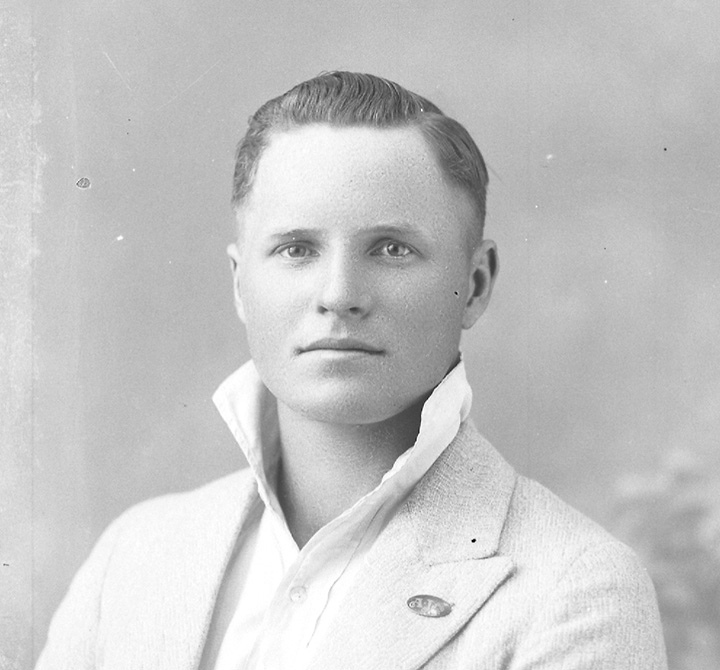
Angus McNeil Studio, Lawrence ‘Lawrie’ Kyle, aged mid-20s, c.1936
When Rob was collecting these stories, I was not yet writing a childhood memoir (Ghost Child: A Memoir) nor had I begun my search for the records. It was more than 20 years before my mind turned towards the idea of writing about that past. Rob was, by this time, in the latter stages of his recording for the Nulla Nulla Creek Project and he invited me to take part in some of the interviews he did with my aunts and uncles. It was not until some years later however that I began reading these oral histories more closely and I found a valuable source for my writing. I also found that this new material challenged my ideas of what that past had been.
Every childhood is lived in a family context (whatever form that family takes) and our family was struggling to survive for most of my early years. As well as writing a story of my childhood, I was also charting the beginning and the end of my parent’s marriage. The end came as I turned 15 and walked out the gate of the local school for the last time. Once the divorce was finalised, Mum did not speak Dad’s name again. For her, that past remained hurtful and harsh and she rarely talked about it except in negative terms. My parents spent the rest of their years well apart, in different states, leading very different lives. It was only in Dad’s old age that I was able to talk to him about his own childhood and adolescence.
But it was Rob’s interviews with Dad and other family members that gave me some fresh insights into that past. As I studied the fragments of my personal history, what I knew and how I knew it shifted inexorably towards a more nuanced view, and I began to see something else. It was not that the events that I remembered were now in greater doubt, but that how I knew them, how I interpreted them and how I told their story had become more porous and open.

Grace Partridge interviewed by Rob Willis, 2006, nla.cat-vn3789113. To see full picture captions, view the video in YouTube.
It is a truism to say that we remember the long past more fondly. Ask a family historian to name their favourite character from any part of the family story and invariably it is a grandmother or a great-grandmother or a great-grandfather. Time can place a romantic, sometimes uncritical, layer on memory. But it also makes sense that we remember this way. We know enough about a grandparent or great-grandparent to tell their stories, but these lives are far enough in that distant past to have lost that edgy currency of the present tense; that place where we know too much. We are less able to blur the closer, known, sharper memories we have of our parents and siblings; these are more challenging, sometimes painful, always raw. And so it is with my parents too.
Not surprisingly, most of the stories I heard about Dad, especially from my mother, were apocryphal – his worst faults, irresponsible behaviour, neglect of his family and an inability to earn enough to keep us fed and clothed. My elderly aunts, his sisters, tell me in their soft, gentle voices that ‘he had good points’. He was a good person, they say, he always helped others. Everyone agrees that he was a rogue, a charismatic charmer. And like all charming rogues, what I hear about Dad is both terrible and terrific. He could have been a preacher, a politician or a powerful advocate for change, but instead I hear that Dad was a small-time conman, a storyteller, a jack of all trades, a philanderer, a charlatan, a ne’er-do-well. How could I reconcile all of these versions of my father and also be true to my mother’s stories and my memories of that past?

Lawrie Kyle interviewed by Rob Willis, 2002, nla.cat-vn628235. To see full picture captions, view the video in YouTube.
I have researched and written enough history, biography and family stories to know that human beings are not one-dimensional. I knew too that it would be wise to find a way to tell the stories of both my parents without malice and with some compassion. There was little doubt that Dad was a charismatic, irresponsible, unfaithful man and a neglectful father. Mum, on the other hand, was strong, resourceful, responsible, caring and always there. I cannot, could not, change any of that. But I can look back with empathy and wonder, with a renewed affection for that past. The Lawrie Stories have seeped into my consciousness too and have tempered my version of it. They do not negate my mother’s memories but add layers of complexity, of human endeavour and human frailty. They tell me of parents who did not always succeed, of a family waking each day to work hard, of parents who had little in the way of material comfort and of hard times that affected all the families who lived in that small dairy farming community along the Nulla Nulla Creek.
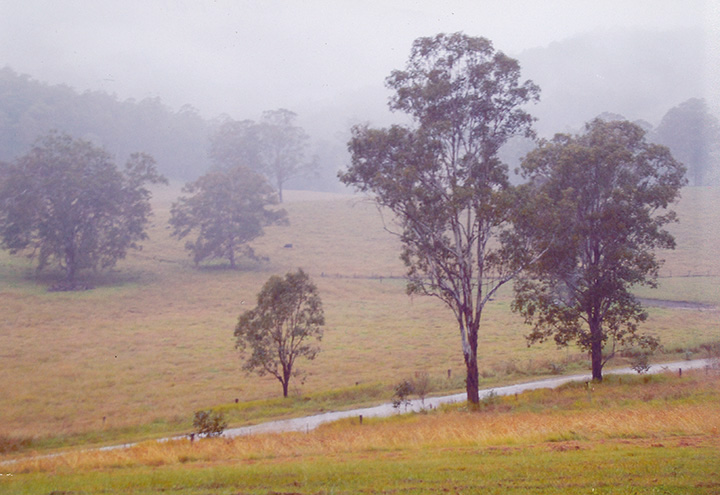
Noeline Kyle, Morning Mist, Kyle Farm, Nulla Nulla Creek
And so I have had to write these stories anew, unravel them and re-arrange the layers to write about my childhood. Both of my parents, in their own separate and singular ways, were full of potential, hardy and hopeful, and both lived long enough to enjoy long, healthy and productive lives well apart from each other. My childhood story is the richer for reading their lives more fully through Rob’s oral history. I can listen to their voices, hear them tell their own stories, know there was hope, understand the toughness, recognise the difficulties but also see the rich tapestry of their lives, over and over again. It is a gift. I am grateful for it.
Dr Noeline Kyle publishes women’s history, biography, memoir and she teaches and publishes widely on how to write family stories. She is an Emeritus Professor at Queensland University of Technology and an Honorary Professor within the Nursing History Research Unit at the University of Sydney.

Saturday, May 11, 2019

Self Publishing Your Family History


Self Publishing Your Family History
By
Noeline Kyle

Stay Local
Stay as local as you can for the publishing/printing process.  Using a local printer/publisher provides for easy access to obtain quotes and to talk to the printer.  If you have extra questions or there is a problem it is easy to contact a local person.  The same rule applies to online printer/publishers.  A local website in your county/country/town/locality is a good first option. It is the case that with online/internet access it is also possible to contact overseas printers/publishers and many of these are an excellent choice also. 

Gather Information via 3 Quotes
Obtain printing quotes from at least 3 printers.  Learn from them.  Ask additional questions as you become more familiar with the process. Here is a preliminary list of questions/ideas for the printers:
·        
200 copies (you can ask for a quote for 20, 50, 100 or 200 copies), in most cases the printer will be offering print-on-demand and the unit cost will not differ (you can check this with the printer when you contact them)
(Print-on-demand is a fixed cost per copy of your book regardless of the size of the order.  In the past typesetter printers would charge less per unit if you ordered 200 copies compared to say 100)

·         26,000 words ( let your printer know the number of words as well as page number)

·         Page size:  A4 is an easy size to work with if you are new to formatting and decide to do it yourself.  A4 allows you to arrange images and text easily.  However, if you decide on a different size, say  C5, 230 x 155 mm you may have to pay someone to do it for you, (more of this later in this blog post).

·         Paper:  something like Satin Art paper, 95 gsm.  Each printer will have suggestions for your publication.  Fuji Xerox have Colotech paper which is 100gsm white, and excellent for producing clear and vivid text and images, (can be purchased from Officeworks).

·         Colour:  no colour, all black and white, including all images, and the cover. Or you might have some colour, and you will be required to detail these.


·         Cover:  You will need to do your own cover and supply a PDF file, more on this later in this blog.

·         Binding:  Perfect binding.


·         ISBN:  It is not necessary to have an ISBN, however including it will identify your book and simplify the ordering process for bookshops and libraries, for Australia, see ISBN Australia  http://www.thorpe.com.au

The Software
For most self publishers the manuscripts will be completed in WORD.  If you are inserting images as you go it is best to work on each chapter individually as large WORD files can become unstable.   Each chapter can be converted to a PDF (if this is how your chosen printer specifies) and then combined into one PDF file with a program like PDF Combine https://combinepdf.com/or CutePDF http://www.cutepdf.com/
Your chosen printer can also combine your files for you.  However, be aware that if you ask another party to combine your PDF or WORD  files the result may shift your images/text in ways that you then have to edit again.  A good strategy is to ask your printer to combine your files and then return the final file to you for checking.  You can take the file to Officeworks or some other printing company and have a draft of your book printed (back to back pages) in a simple print edition that can serve as a draft for you to work from.

Be Realistic
If you are not confident to do your own editing and/or formatting then you can employ individuals to do this for you.  For some straightforward advice on editing see my chapter 4, p.42 of my ebook Writing Family History Book 5: Publishing your family history, a practical guide obtainable from Amazon at:  https://www.amazon.com/-/e/B001JPA1MM for $2.79 AU.
For formatting your text you can ask a family member who is confident and experienced with this task to do it for you.  If you do not have a friend or family member to help and you would like to employ a professional then look at the following and choose several, say 3, and obtain a quote for the work you want them to do, Australian Book Designers Association https://abda.com.au/members/
You can also use this association to find  a cover designer as well.  You will need to provide some information on what your approach is both for the formatting (book size) and for the cover provide information about the major themes and what images you might like on the cover.
For example when I was publishing a book on Midwives of the Mid North Coast, one of my major sources were the almost daily and/or weekly advertisements these women placed in local newspapers.  The book designer Karen Scott Book Design cleverly used these to design a cover that mimicked a newspaper page.  She also utilized an image of a midwife with a baby and photographs from the main streets of the towns featuring children and/or historical scenes, see following images:


The back cover should have a description of your book content plus a biography of you, the author, see above:

©Noeline Kyle 2019


Tuesday, May 7, 2019

Copyright

https://mgnsw.org.au/sector/resources/online-resources/organisation-management/copyright-basics/

Copyright: the basics


This resource has been compiled using material from the Australian Copyright CouncilArts Law Centre of Australia and the Copyright Agency. These agencies provide excellent factsheets and resources on all aspects of copyright, some of which are attached here as downloadable material.

What is copyright?

Copyright is a set of rights that provide protection for all kinds of artistic products. It protects them from being copied, changed or exploited and acknowledges that the artistic product belongs to someone.
In Australia copyright is free and exists automatically once an artistic product is created.
It is determined by the Copyright Act 1968.
Copyright can be denoted using the © symbol. Failing to display the © symbol does not extinguish copyright.

Who has it?

Copyright is owned by the creator and/or by a collecting institution.
If the creator is commissioned or contracted to make the work, or if it is made under normal employment, the standard copyright rules can change. For example:
  • When a work is created as part of regular employment the copyright is generally owned by the employer.
  • When a work such as a painting or photograph is commissioned or made under contract the commissioning organisation/person usually holds copyright. However this may not apply if the artist is working freelance.
  • With films and sound recordings the producer usually own copyright though in some situations performers can share copyright.
It is critical to have a contract which clearly specifies the terms of copyright.

How long does it last?

In Australia copyright begins when the work is created and generally lasts 70 years after the death of the creator.
Exceptions occur: copyright on sound recordings last 70 years from the date of the first publication and copyright on published written work is 25 years post publication date.
Once copyright lapses the work is considered in the ‘public domain’ which means that anyone can use it.
For example, copyright has expired on photographic images and negatives (although not their digitised copies) taken before 1955. For any photographs taken from 1955 on, copyright is for 70 years after the death of the creator.
Other countries have different copyright rules and timeframes.

Managing copyright

There are two main ways of managing copyright which are used when an organisation or an individual want to reproduce or use a copyrighted work which is not their own.
The copyright owner can either assign or licence a third party which transfers all, or some of the rights associated with copyright to that person/organisation.
Both these transfers must be done in writing and the process is best done with legal advice and a formal contract.
Be aware that it is not necessary to register something for copyright, though there are organisations in Australia who can manage licencing fees resulting in use and publication of work. See Copyright AgencyViscopy, and the Australasian Performing Right Association (APRA).

What about Indigenous work?

Copyright and intellectual property rights of Indigenous cultural product may vary from the Copyright Act because ownership is often intergenerational and group-owned.
Appropriation of Aboriginal imagery such as pattern, motifs, spiritual figures, or story by non-Indigenous artists is considered as cultural theft and a breach of cultural protocols.
There are specific protocols and permissions around using and taking photographs of Aboriginal people that should be observed and having signed model release forms is desirable.
Arts Law suggests that Indigenous copyright be clarified through contract. They are specialists in the field with an Aboriginal liaison officer who can provide advice and the dedicated Artists in the Black website. Arts Law offers workshops which provide an in-depth explanation of Indigenous copyright issues and the implications of breaching protocols.

Provisions for collecting institutions

Under Australian copyright law collecting institutions are allowed to copy material in their collections to maintain and conserve the collection as long as the collection is not-for-profit.
Museums and galleries fall under the definition of an ‘archive’ which is considered by law to be “a collection of material of historical significance or public interest, being maintained for the purpose of conserving and preserving the material.” (Australian Copyright Council, Information Sheet G068v07)
Key collection institutions (defined as those holding an archive of material which is of historical or cultural significance to Australia) can make three preservation copies of original material, editions, films and sound recordings. Other collecting institutions can make one copy of the original version for preservation.
These images, usually photographs, also carry copyright which is owned by the collecting institution.

Moral rights

Moral rights are different to copyright and exist as a complementary set of rights or obligations that must be observed when collecting, displaying or exhibiting artworks or objects.
Moral rights include correctly and accurately attributing the creator of the work and caring for, or displaying the work in a way that does not prejudice the creator’s reputation or honour.

What’s the public domain?

When copyright has formally expired the material is considered to be in the public domain. This means that people can use it without seeking permission.
Exceptions exist: all digital copies of old photographs currently attract copyright under Australian law, as digital images are considered to be an artistic product in their own right.
Collecting institutions own copyright on these images and are entitled to charge for reproductions/prints of them.
It’s important not to confuse online availability with something being in the public domain. Online images are often subject to the same copyright rules and have restrictions on their use.

What is a Creative Commons licence?

Providers such as Google Images, Flickr and Wikipedia Commons offer access to digitised material through the Creative Commons licence. A range of licences are available, most of which require attribution to the creator and a declaration if changes have been made to the work. Creators are able to limit the type of use or adaption.
For more information: Creative Commons Australia

What if it’s on social media?

Standard copyright law usually applies: users own and retain copyright of what they post, create, or contribute to a website, social network or other online service.
There are exceptions. Tweets, comments and short phrases of text are usually considered to be outside copyright because they are of general usage and no significant individual contribution to ownership can be demonstrated.
Best practice in using this kind of material is to request permission from the contributor and to document the response. If an organisation is using shared material via social media it is a good idea to ensure the Risk Management Policy outlines responses to copyright breaches.
In signing up to, or opening an account on many social media platforms such as Twitter, Facecbook and YouTube, users agree to give permission for their material to be shared. In most situations privacy settings can be altered to control some of the ways the provider uses and distributes the material.
Social media is a complex copyright area and in many cases the technology means that copyright and breaches of it is difficult to control.

Be aware that …

Copyright does not protect ideas, information, techniques or style. It does not protect names, slogans or titles.
While all care has been taken to ensure information is accurate at the time of publication, all information in this resource is intended as a guide only.  You should obtain professional advice if you have any specific concerns.

You may also like:

Australian Copyright Council: Find an Answer